Introduction
In this post, I will do some light analysis on partnership pairings in T20 cricket. We’ll look at whether or not it’s beneficial to pair left-and right-handed batters together, as well as whether or not it’s beneficial to pair pace-favoring batters with spin-favoring batters. This is not meant to be a thorough or comprehensive analysis-simply a look at some high-level data to see if there are any obvious conclusions to be drawn.
Partnership Pairs by Batter Handedness
First, we’ll look at partnership pairings by batter handedness. The theory here is having a right/left partnership at the crease is more challenging for the bowling team. Fairly simple logic-with a partnership split by handedness, the fielding team has to change fields more often and bowlers are forced to change their lines more often. Additionally, the batting team may be able to better avoid handedness-based weaknesses by strategically rotating the strike.
We’ll look at performance by partnership pairing across T20Is and major domestic leagues. We’ll only look at the first three partnerships of each match (i.e., when the batting team is down 0/1/2 wickets), as this guarantees we’re looking at top-level batters, and this is when the batting team has the most control over which partnerships are at the crease.
Here is a table showing Strike Rate and Balls per Wicket for each league and partnership pairing:
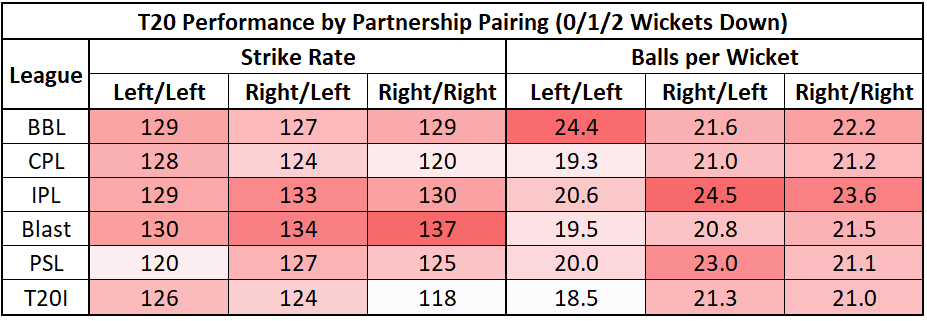
Some of this analysis is influenced by differences between Left- and Right-handed batters in certain leagues. In particular, Right-handed batters perform much weaker in the CPL and in T20Is.
Otherwise, there’s a bit of a mixed bag of results across the board. In the IPL and PSL-arguably the two biggest and most advanced (analytically speaking) leagues in the world, it does appear that Right/Left partnerships have slightly stronger strike rates and last longer than same-handed partnerships. But other leagues don’t obviously show this pattern-the BBL seems to show that Right/Left partnerships are marginally weaker.
Conclusion: All in all, there is some evidence that Right/Left partnerships perform slightly better than same-handedness partnerships, particularly in the IPL and PSL. But this doesn’t seem to extend to all leagues, and the benefits remain relatively minor. If it doesn’t involve putting a weaker batter at the crease, it seems beneficial to opt for a mixed-handedness partnership when the batting team can do so.
Partnership Pairs by Pace/Spin Preference
The other consideration when determining strong partnerships is whether the batters favor pace, favor spin, or are equally adept at both. Here, a “split partnership” (i.e., a batter strong against spin paired with a batter strong against pace) would allow the batting team to rotate the strike to avoid weakness and exploit matchups against the bowlers. A partnership between two pace-hitters or two spin-hitters could make it easy for the bowling team to exploit batting weaknesses (i.e., putting a spin bowler in against two batters that love pace).
In this analysis, we’ll again focus on the first three partnerships of the match, and look at data from only the IPL-spin conditions vary across the world and isolating a single league will be the cleanest analysis. In general, strike rates against Pace are stronger than strike rates against Spin. So a “Pace Hitter” is defined as a batter who has a strike rate against Pace that is +13% or more better than their strike rate against Spin. A “Spin Hitter” is a batter who simply has a higher strike rate against Spin than against Pace. The remaining hitters are classed as being “Even”, with no strong preference for Pace or Spin.
Here is a table showing Strike Rates and Balls/Wicket by partnership type:
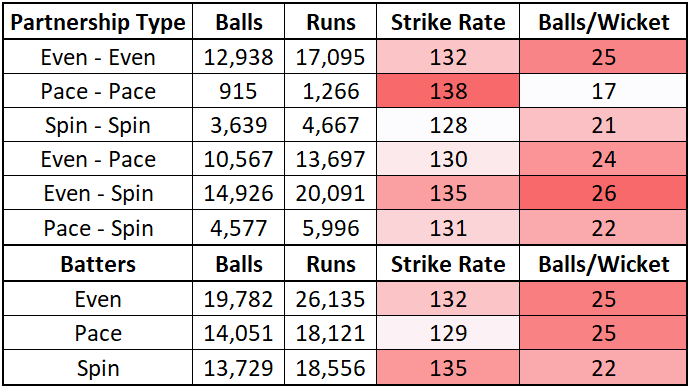
The results are mixed. It’s certainly not clear that a Pace-Spin partnership is obviously better than the alternatives. There is some evidence that Pace-Pace (loses wickets often) and Spin-Spin (low strike rate and loses wickets often) partnerships are weak and easily exploited by the bowling team.
Conclusion: All in all, it seems best to avoid partnerships that pair two players that specialize in hitting pace or spin. This makes it too easy for the bowling team to counter with a bowler that can exploit their weakness or at least neutralize a strength.
Conclusions
In summary, there may be some evidence that Right/Left partnerships perform better than same-handed partnerships. There is less evidence that pairing Pace-favoring batters and Spin-favoring batters yields stronger performance, but it is at least apparent that you don’t want to pair batters together that both favor Pace or both favor Spin.
In general, given the relatively weak advantages at play within this analysis, it’s perhaps more important to consider other factors when constructing a game plan-players’ preferred role within the batting order, speed running between the wickets, and the experience of two players batting together.
 Cricket Sims
One thought on “T20 Partnership Analysis”