Months after the thrilling finale of the 2019 ODI World Cup, qualification for the next edition in 2023 is already underway. The road to the World Cup involves 32 teams across 4 competitions that will stretch multiple years ahead of final qualifiers and the 10-team (still far too small!) World Cup. The 4 competitions (3 levels) are:
- World Cup Super League: This league contains the top 13 teams in world cricket-the 12 full ICC members in addition to the Netherlands, who qualified as a result of winning the 2015-17 ICC World Cricket League Championship. The top 7 teams plus India will advance to the 2023 World Cup, while the bottom 5 teams excluding India will advance to the World Cup Qualifier.
- World Cup League 2: The next level down includes 7 teams-Nepal, Scotland, and the United Arab Emirates (by virtue of previous ODI status), in addition to Namibia, Oman, Papua New Guinea, and the United States of America (from the final World Cricket League 2 in April 2019). The top 3 teams in this competition will advance to the World Cup Qualifier, with the bottom 4 dropping to the World Cup Play-Off.
- World Cup Challenge Leagues A/B: At this level, there are 2 leagues of 6 teams each from various levels of the old World Cricket Leagues. The top finisher from each group will advance to the World Cup Play-Off.
This tweet from Bertus de Jong gives a good visual of the complete process, which provides a more stable cricket schedule for many associate sides over the next few years:
Next we’ll look at the current state of each of the four leagues, as well as placement probabilities for each. Probabilities are based on 2,000 simulations.
World Cup Super League
The World Cup Super League will see each of the 13 teams play 24 matches in the form of 8 3-match ODI series-4 at home, 4 on the road. This means each team will not play 4 other sides in the competition, which obviously leads to significant schedule imbalance. The full schedule can be found here.
The competition will get underway in May 2020 when Bangladesh travels to Ireland. Here is the current state of simulations for the competition (Note: India automatically advances to the World Cup Qualifier-this is not reflected in the table below, but is reflected in the rest of the simulations):
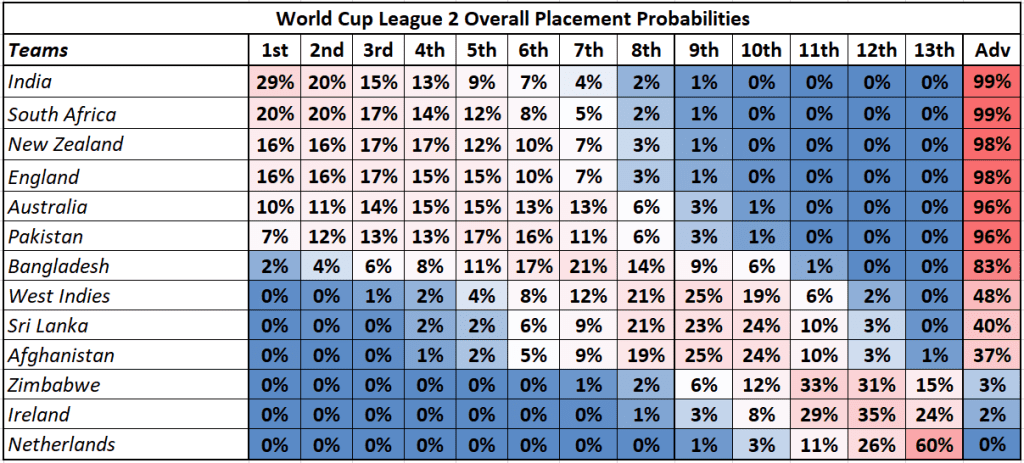
The top 5 teams after India in World Cricket are near-locks to make it straight to the World Cup: South Africa, New Zealand, England, Australia, and Pakistan. Bangladesh-by virtue of not playing India, Australia, and South Africa-are also in good position to advance. After that, West Indies, Sri Lanka, and Afghanistan are fighting for the last direct qualification spot or a chance to unseat one of the top 7. Zimbabwe, Ireland, and the Netherlands are all a step behind and long-shots to qualify directly to the World Cup after all missing out on the 2019 edition.
World Cup League 2
The schedule for the World Cup League 2 is much more equitable than the Super League. Each of the 7 teams plays every team 6 times-twice at home, twice away, and twice at neutral sites. Each team will be a part of 9 tri-series over 3+ years, meaning a solid total of 36 guaranteed matches per team, 12 more than the Super League.
As of this writing, 4 of the 21 planned tri-series have been played-the United States have gotten off to an early lead with 6 wins from their first 8 matches. At the other end of the table, Papua New Guinea are 0-8, while Nepal has yet to play a match.
Standings and Simulations:
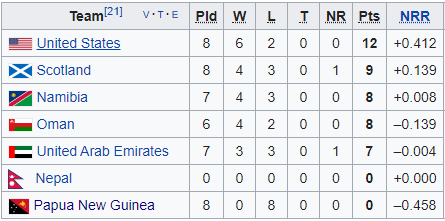
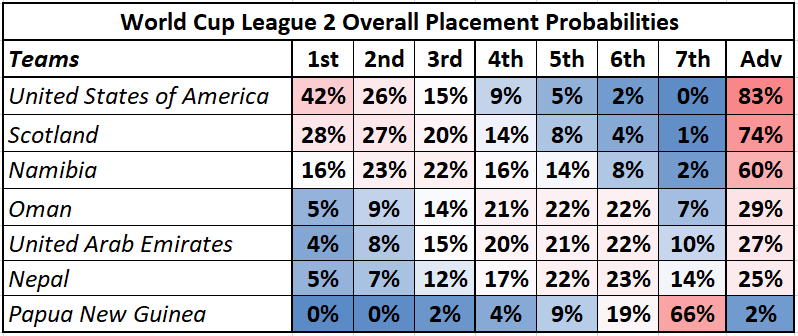
The fast start and resulting strong ratings give the USA a solid chance of making it straight to the World Cup Qualifier. Scotland were strong favorites coming into the competition, but a mediocre start has left them some work to do going forward. Namibia rounds out the expected Top 3, with Oman, United Arab Emirates, and Nepal also expected to be in the mix. Papua New Guinea would need a dramatic reversal of fortune to get straight to the World Cup Qualifier.
World Cup Challenge Leagues
Each Challenge League will be played as 3 single round robin tournaments, with each team getting a total of 15 matches. There is some schedule unbalance here as only a few teams will get the advantage of home field. The teams are split as follows:
A: Canada, Denmark, Malaysia, Qatar, Singapore, Vanuatu
B: Bermuda, Hong Kong, Italy, Jersey, Kenya, Uganda
World Cup Challenge League A
The first series in League A took place in Malaysia in September, with the next coming up in mid-March, again in Malaysia. Standings and Simulations:
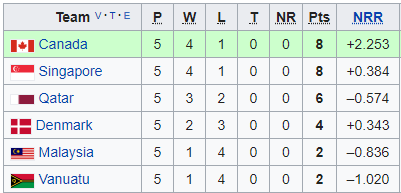
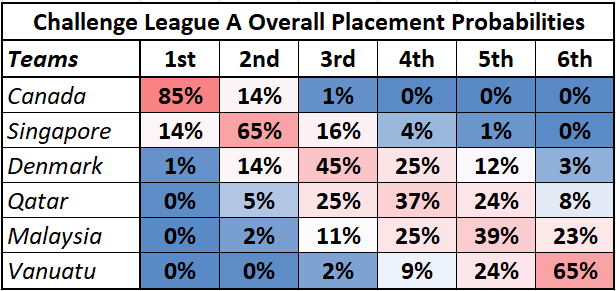
Despite being tied on points with Singapore, Canada is well ahead on run-rate, after posting two scores over 375 in the first round in Malaysia. Canada’s only loss came by just 4 runs against Singapore in a rain-affected match on the final day. The model accounts for margin of victory and accounts for NRR in the simulations, which means it loves Canada, giving them an 85% chance of winning the league even after just one round. Malaysia is hosting at least two-thirds of the league but won’t threaten Canada’s position.
World Cup Challenge League B
The first round of Challenge League B took place in Oman last December, after civil unrest forced it out of Hong Kong. The next stage is scheduled for Uganda in July. Standings and Simulations:
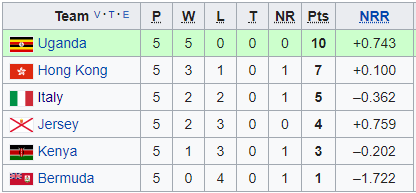
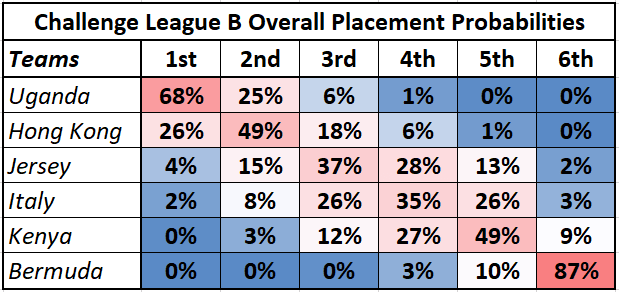
Uganda benefits from a perfect start and hosting duties to sit as a solid 68% favorite to take the league. The model rates Jersey and Hong Kong not too far behind Uganda, but under-performance from Jersey and an unfortunate washout for Hong Kong against Italy set them back in what’s ultimately not a super-long competition.
With all of this information, we can move on to simulating the World Cup Play-Off and World Cup Qualifier to see each team’s probability of advancing to the 2023 Cricket World Cup.
World Cup Play-Off
The World Cup Play-Off will consist of 6 teams, and while the format has not been announced, it can be assumed that it will be a single round-robin, with the top 2 teams advancing to the World Cup Qualifier. The 6 teams will consist of the bottom 4 from World Cup League 2, and then the winners of each of the two Challenge Leagues.
The somewhat messy table below shows-by Level-the probability of each team finishing in a given position in the World Cup Play-Off, as well as the probability of each team actually participating in the Play-Off, the probability of each team advancing to the World Cup Qualifier from the Play-Off, and finally the probability of a team advancing to the World Cup Qualifier if they make the Play-Off.
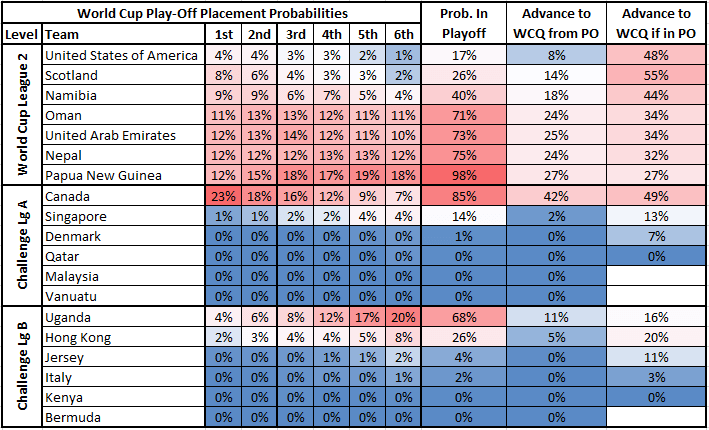
A look at the bottom 4 sides from World Cup League 2 shows that this is likely to be a wide open and competitive series no matter who takes part. Oman, the UAE, and Nepal are all just about equally likely to finish at the top or the bottom of the table.
As we saw earlier, Canada is very likely to feature in this leg of qualification, and if they make it here, the model gives them nearly a 50% chance of finishing in the top 2. This is perhaps not surprising, as Canada missed out on being in League 2 by the slimmest of margins on NRR in the final World Cricket League Division 2 in April 2019.
The story is not so optimistic for the winner of Challenge League B-likely Uganda at this point, who would have just a 16% chance of advancing to the World Cup Qualifier if they are able to win their league.
World Cup Qualifier
Group Stage
Ten teams will take part in the World Cup Qualifier: The bottom 5 teams from the Super League, the top 3 teams from League 2, and the 2 top teams from the Play-Off. It can be assumed that this tournament will have the same format as the previous 10-team World Cup Qualifier in 2018, which saw the West Indies and Afghanistan advance to the 2019 World Cup.
The first stage would consist of two groups of 5 running a single round robin each, with the top 3 teams advancing to the Super Sixes stage. This table below gets even more complicated, as every team (except India) can theoretically make this stage of the competition. Extra columns are the same idea as before.
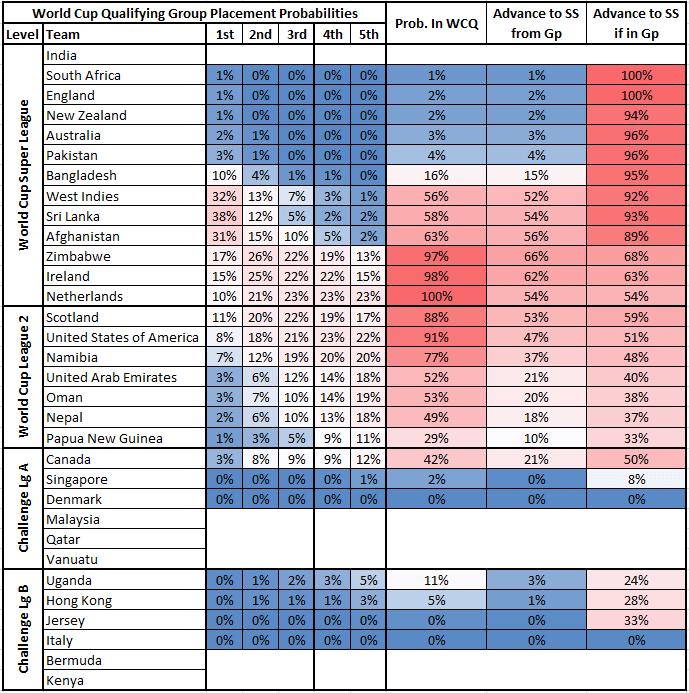
Outside of India, there are a few other teams that did not make this stage of the competition over 2,000 simulations-Malaysia, Qatar, Vanuatu, Bermuda, and Kenya. Jersey featured 9 times (advancing three times) and Denmark and Italy each got in once, finishing last. None of this was enough to round up to 1% from 0%.
Otherwise, this is basically the usual suspects of who you would expect to be in a World Cup Qualifier-many of the same teams as the last edition. Important to note that one team would likely be the host and get some boost from home field advantage that’s not accounted for here.
A couple interesting nuggets-it’s not likely that any “Top 6” team ends up here, but over 2,000 simulations, Australia and New Zealand were eliminated from World Cup contention at this stage twice and Pakistan three times.
Super Six Stage
The top 3 teams from each group will advance to the Super Sixes. Results from the Group Stage will carry over, though I have not yet coded that into the simulations. Each team plays the three teams from the other group to complete a single round robin, with the top 2 advancing to the 2023 Cricket World Cup.
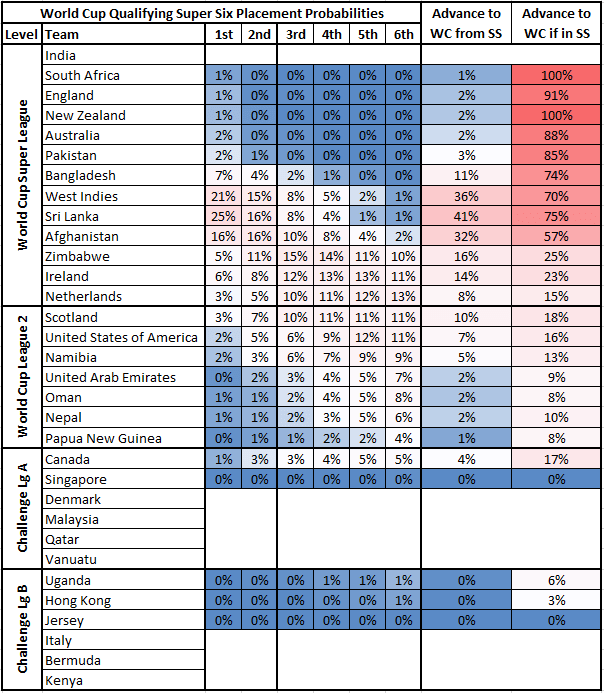
The three teams most likely to advance to the World Cup via the Qualifier are West Indies, Sri Lanka, and Afghanistan-two of whom (WI and AFG) did so in 2018. Fellow Super Leaguers Zimbabwe and Ireland are a tier down around 15%, with Scotland, Netherlands, and USA hovering around 10%. Outsiders Uganda and Hong Kong did make it to the World Cup 3 and 1 times, respectively, out of the 2,000 simulations.
Final World Cup Qualification Probabilities
With all of this, we can now calculate the probability of each team making the 2023 World Cup!
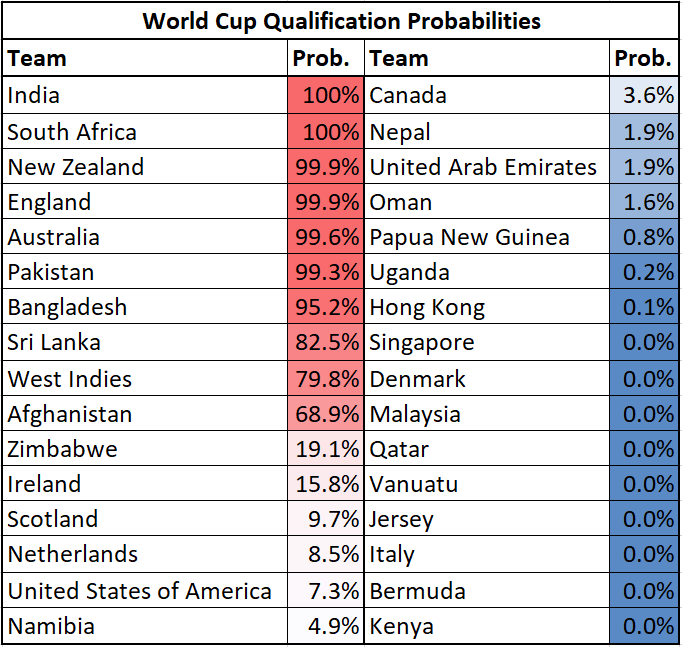
At this stage, the top 10 here are the exact 10 teams that made the 2019 World Cup. That’s an unfortunate outlook for those excited for some new faces, but from a purely mathematical standpoint, makes sense given that these 10 teams performed the best in order to qualify last time around. Hopefully we see some movement in the next few months as the Super League gets under way.
 Cricket Sims