Introduction
My previous blog post outlined methodology for estimating Bowler Impact-in other words, the number of runs per over above or below average a bowler adds to the opposition’s total. This analysis accounts for the match states in which a bowler appears-overs and wickets left-as well as the estimated run value of a wicket.
In T20 cricket, that value was -4 runs per wicket. Replicating that analysis for ODIs (or 50-over cricket in general), we find a value of approximately -12.5 runs per wicket. For a longer format, it’s obviously reasonable for a wicket to be worth more runs, as batsmen tend to last longer and it’s more likely for a team to be bowled out. Otherwise, everything else about the analysis is the same. Let’s apply it to the ongoing Cricket World Cup League 2!
Top Ten Bowlers
Here are the top ten bowlers for the competition to date (minimum 20 overs):
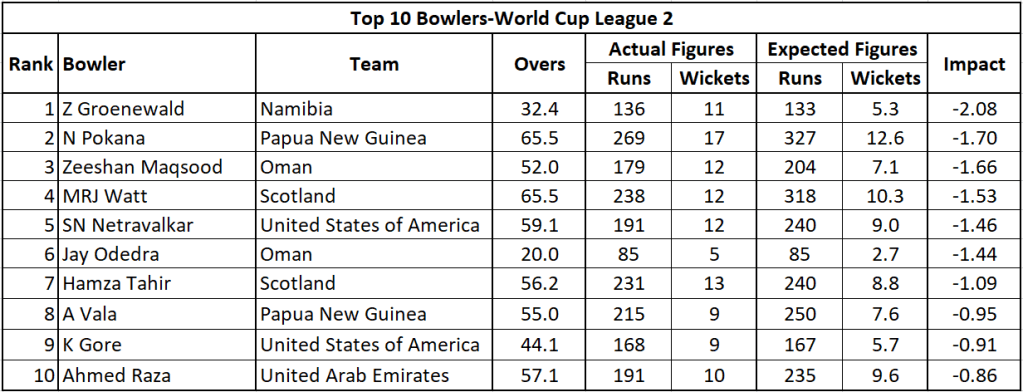
The top bowler in the competition so far is Zhivago Groenewald of Namibia, who only featured in the United States Tri-Series before not seeing any action in Oman due to a knee injury. Groenewald led Namibia to a big win against the United States in Florida with a 5/20 performance, in addition to two other 3-wicket hauls in the tri-series. The United States has three of the top ten, anchored by captain Saurabh Netravalkar and the off-spinner Karima Gore. Overall, the top ten sees representation from every team that’s played so far.
Team-by-Team Bowling Analysis
Next up, we’ll take a team-by-team look at bowling performance for the competition. Teams will be ordered from best to worst by Bowling Impact.
United Arab Emirates: -0.26
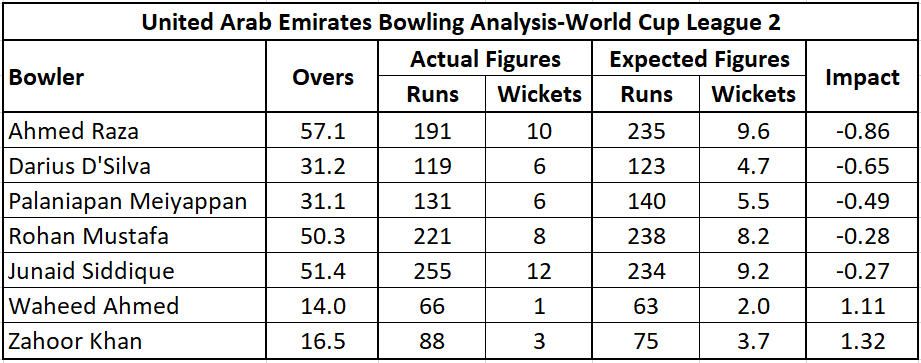
Despite not having any top nine bowlers and just a 3-3 record in the tournament so far, the UAE still sport the strongest bowling attack of the competition. The UAE boast 5 regular bowlers at about a quarter of a run below average per over or better, and no weak links in their usual bowling attack. Captain Ahmed Raza leads the way, forming a restrictive partnership with fellow spinner Rohan Mustafa throughout the middle overs, together allowing about -18% runs fewer than expected between overs 11 and 40.
Death bowling has been something of a strong suit for the UAE, spearheading two of their three wins against Scotland (185/4 to 220 all out in the last 12 overs) and Namibia (defending 67 runs in the last 10 overs). In total, the UAE has taken 35% more wickets and allowed -20% fewer runs than expected in the final 20 overs.
United States of America: -0.09
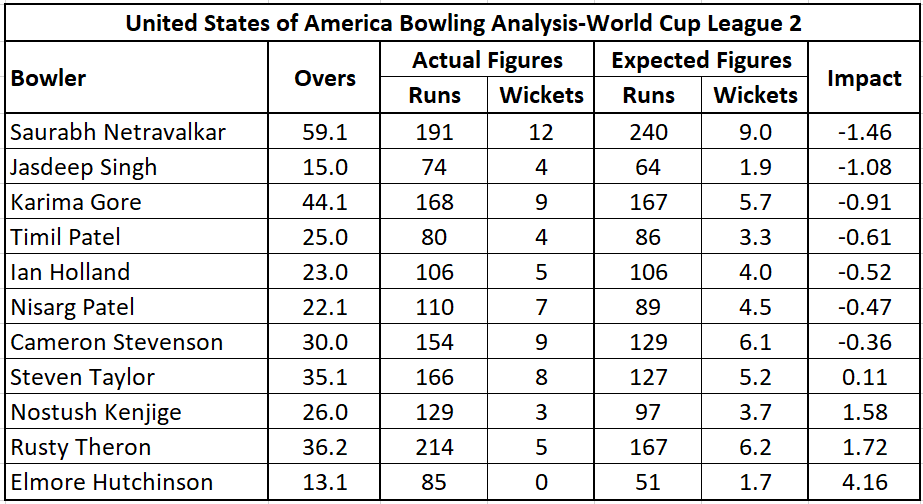
Even after losing the services of arguably their best bowlers in Ali Khan and Hayden Walsh Jr., the United States has still put together an elite bowling attack. Much of this strength comes from their captain Saurabh Netravalkar, whose precise bowling in the opening overs has led the USA to their 6-2 start in the competition.
In the first 10 overs, Netravalkar has taken 8 wickets for 89 runs at an average of 11.1-this is an incredible -33% fewer runs than expected and almost twice as many wickets as expected in this time period. His death bowling has been equally outstanding, including single-handedly bowling out the UAE for 202 from 190/6 on their home turf.
Karima Gore was a revelation for the USA in their home tri-series, taking figures of 3/25, 2/15, and 4/20 in successive victories to start their World Cup League 2 campaign. Unfortunately he went down with an injury partway through the next set of matches in the UAE. If he’s not back for the Nepal series, the USA will rely on their spin depth of Timil and Nisarg Patel, as well as Steven Taylor.
Namibia: +0.07
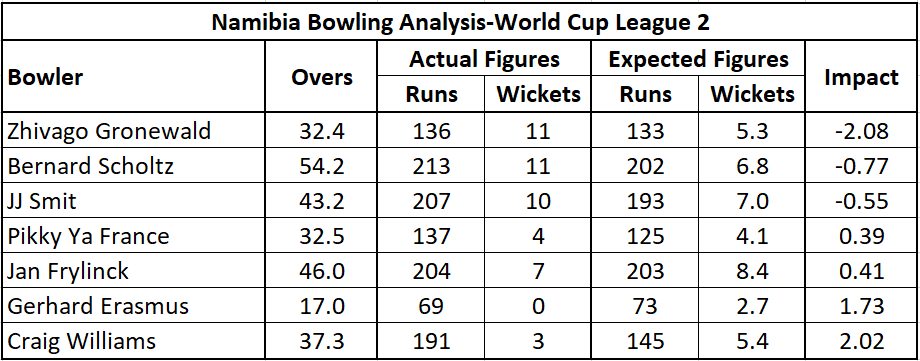
The tournament’s top bowler, Zhivago Groenewald, leads the Namibian bowling lineup. Groenewald restricts opponents’ totals by an impressive -2.08 runs per over, but has been sidelined by a knee injury since the tri-series in the United States.
The opening bowling partnership of Jan Frylinck and JJ Smit has been solid, if unspectacular, combining for an impact of -0.32 runs per over in the first 10 overs. Bernard Scholtz has been reliable in the middle overs for Namibia, including figures of 4/27 in a defense of 260 against Papua New Guinea in the USA.
There’s not much to look at in the rest of Namibia’s bowlers-Craig Williams has been expensive and relegated to the middle overs after a couple unsuccessful stints opening the bowling.
Scotland: +0.13
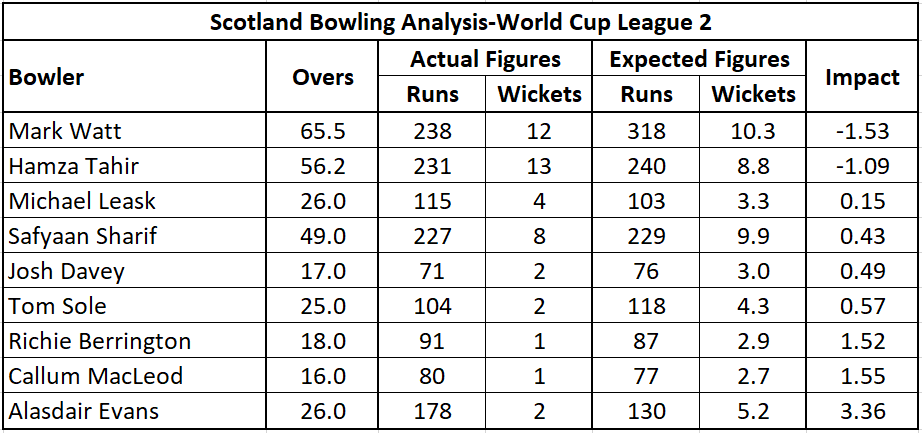
Scotland would always have hoped to bat their way into the World Cup Qualifier, but the bowling has really struggled. Their top 3 and only above average performers are spinners. This spin trio has been consistently solid in the middle overs, both restricting runs and taking regular wickets-combined, they restrict opponents’ totals by -1.34 runs per over between overs 11 and 40.
Outside of this limited success though, it’s been bleak. Scotland allow more runs than average in the first ten overs (+0.45 per over) and the last ten overs (+1.23 per over). This proved fatal in a 35-run loss to the United States, who piled on 77 runs in the final 10 overs, and again against the UAE, who chased down 220 with relative ease after a start of 62/0 in the powerplay.
Papua New Guinea: +0.18
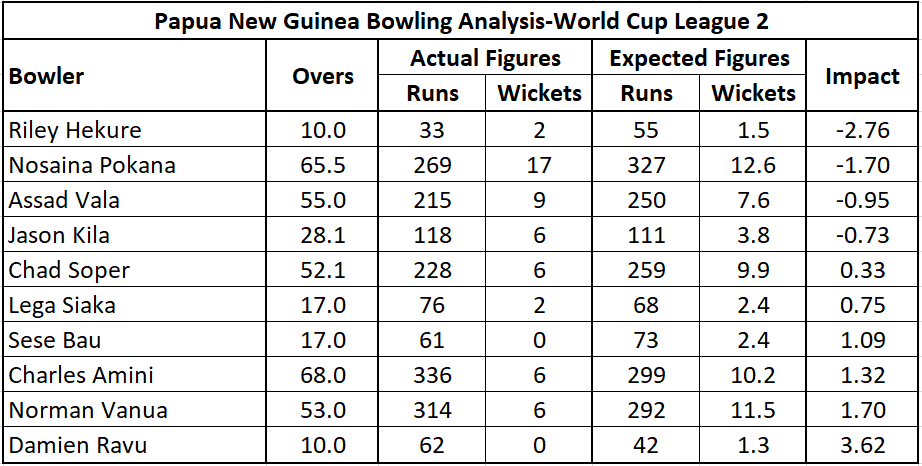
The bowling attack that led Papua New Guinea to the T20 World Cup has been largely ineffective in the 50-over format as they’ve sunk to a potentially insurmountable 0-8 start in the competition. Much of this is down to Norman Vanua and Charles Amini, who are increasing their opponents’ totals by a combined 1.5 runs per over and together account for 31% of PNG’s overs bowled.
One bright spot has been fast bowler Nosaina Pokana, one of the tournament’s top bowlers to date. He’s taken a tournament-leading 17 wickets (including 6 multi-wicket outings) while restricting opponents to -17.7% runs fewer than expected. He’s done most of his damage in the opening and death overs, supported by some reasonable middle-order stability from Assad Vala. Ultimately, Papua New Guinea will need improved bowling depth to compete.
Oman: +0.21
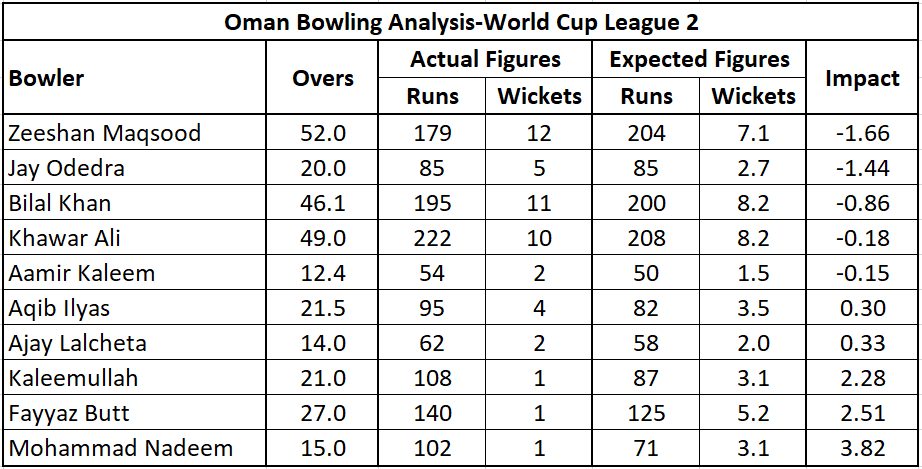
Oman is last on this list largely due to bleeding a tournament-high 324 runs against Namibia last week. They’ve had some solid performances otherwise, bowling Scotland out for 168 in their second match and bowling UAE out for 170.
Zeeshan Maqsood, along with UAE’s Ahmed Raza and USA’s Saurabh Netravalkar, is the third captain to lead his team in bowling performance. In the first match of the UAE tri-series, he bowled out UAE for 170 from 146/6 in the last 12 overs, in addition to a 2/32 performance against the hosts in Scotland to secure a huge road win.
Conclusion
All in all, the Cricket World Cup League 2 has been a competitive and exciting tournament to date. Here is the current state of the competition, per my ratings and simulation models:
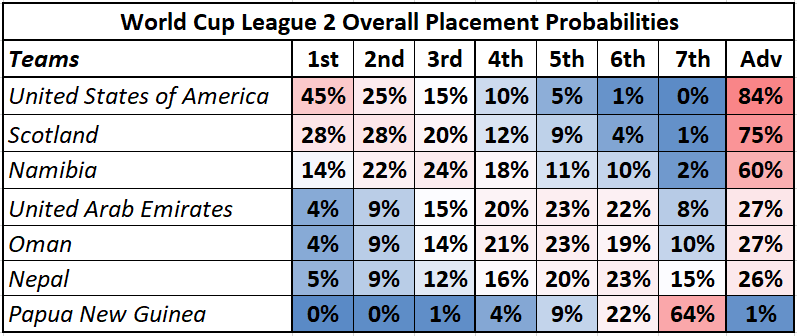
Papua New Guinea has taken themselves out a bit after their winless start, but the rest of the table is more or less up for grabs. USA has had the strongest start at 6-2, and Scotland were pre-tournament favorites. Namibia was in great shape before losing a couple in Oman, and that’s opened up the race for the third spot in the World Cup Qualifier, though even the USA and Scotland shouldn’t feel safe quite yet.
Hopefully this bowling analysis has given a useful team-by-team view of the state of the competition from a bowling perspective. I hope to publish a similar analysis for batting over the next few days.
 Cricket Sims